NOTE: This page will be considered a draft for a good while, but I want to go ahead and publish it anyhow. I hope brother Steve, Aunt Phyllis,, and Clint Harris will add to it. I expect to add more pictures with narrative as I scan them. So, I don’t really expect the overall narrative to ever be real smooth. It’s more important to me to record all the memories and history so everyone can see them. It is a living, breathing document.
Mom and Dad, Dave and Steve started living at 15701 Blackstone around December of 1939. They moved from just up the street. Steve would have been less than a year old; Dave about two. We stayed there until Spring, 1958 when we moved to Ferndale.

I remember Mom and Dad paid $75 per month rent. There were two bedrooms, kitchen, dining room, living room, and a basement. The four boys all stayed in one bedroom at first. Phil and I were in bunk beds, and Dave and Steve had roll-away beds. When Dave and Steve got older, and handier, they built themselves a room in the basement.
We had a coal furnace, and, of course, no air conditioning. We had no hot water on demand in the summer when the furnace wasn’t operating. Steve describes the setup in his memoirs: “There was a gas burner that heated a coil that went into a tank. The gas was only turned on before someone wanted to use hot water to fill the bathtub. A pipe also looped into the coal burning furnace for hot water in the winter.” When Mom or Dad washed the dishes in the summer, they would heat up water in a kettle, put the clean dishes in a rack and pour hot water over them to rinse the soap off. This was called scalding the dishes. Dave said later that in the winter, when the furnace was running, the water got so hot that the faucet would steam and sputter before the water came out.
The house was on the corner of Midland and Blackstone, in the Brightmoor district of Detroit. I read a writeup in Wikipedia about Brightmoor. A developer bought up the land in the early 20s, while it was still outside the city limits, and built modest houses specifically for people (white) coming up from the south to work in the booming auto industry. There are several videos on line about Brightmoor, most of which are some guy driving around talking about how blighted it is. It apparently is one of the most devastated neighborhoods in Detroit. There are some more upbeat videos talking about some of the community action efforts. A friend of mine is friends with one of the community organizers and a Facebook post came up on my friends page wanting contributions. I had to kick in.
Here’s our house today.

There was a big side yard which made us popular for playing football and other activities. I guess ours was a typical working class neighborhood. There were lots of kids around. Although I didn’t realize it until later, the house was kind of shabby. Steve, in his page about Phil, talks about how embarrassed Phil was about our place.
The Coronado Baptist Church was three blocks South. I remember it as a modest building with a large room and tables for different age groups. Recent pictures in Google Maps lists it as both Coronado Baptist Church and Mt Vernon Missionary Baptist Church. It is brick, and definitely now Mt Vernon. Mom made Dave and Steve dress up and walk to Sunday School every week. We brought our offering of a dime in a tiny envelope and the teacher, Mr Whaley talked about various passages from the Bible. Later Phil also went voluntarily with Eileen Chandler. Phil was more inspired than his older brothers and wanted to become a preacher. We never went to a church service where the alter and pews were. Mom and Dad went to the adult Sunday school class once, where the group spent the entire time arguing about the structure of the wall of Jericho. Dad whispered to Mom, “Let’s get the hell out of here.”
In his page about Dave, Steve talks about all of their friends, some of which were a bit sketchy. I was 10 +/- years younger than Dave and Steve. I knew all their friends but was just a pain in the neck little brother. But next door were my running buddies, Clinton and Sherwood Harris. Clint, on the right, has a classic mischievous look.
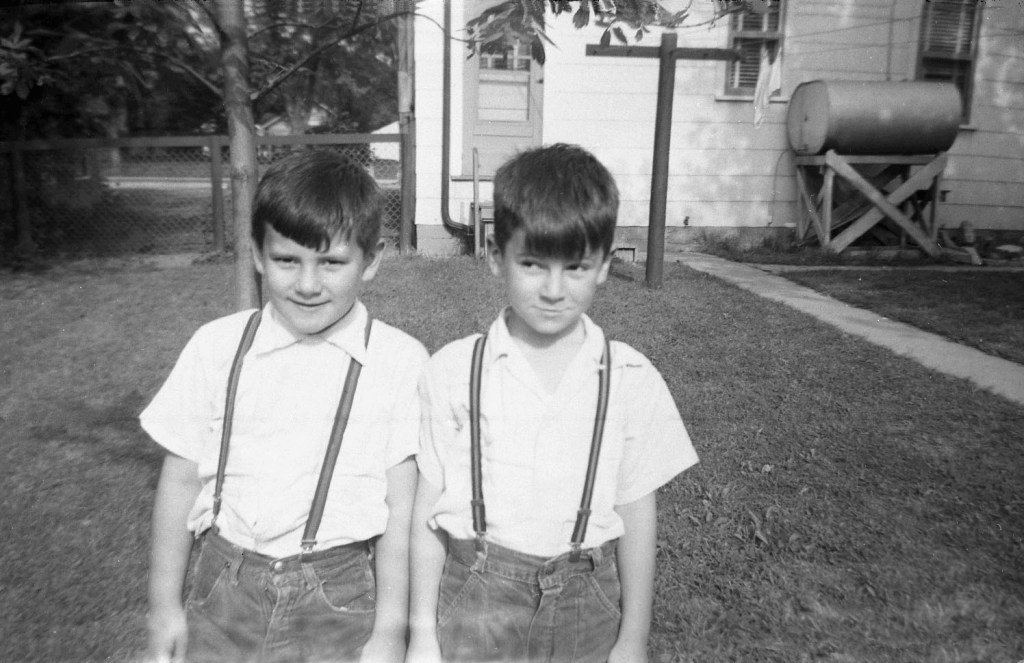
Clint and I became reacquainted via Facebook in the last year. We moved away in 1958. I ran into him on Wayne State‘s campus in the late 60s but lost track of him until recently. The band I play in had a tour of the west last year. Clint and his wife Carol live a few miles from Virginia City, Nevada and came to see us. It was great fun catching up. He remembered some things about the old neighborhood that I had forgotten. I hope Clint will contribute some of his memories to this page.
One of our friends, Steven Pollock, used to beat sticks in rhythm and tell these fanciful tales while we gathered around. I remember it being quite odd, but fascinating. I imagine he might have become a poet or writer. We also would regularly convene in a sandbox in our yard and make these farms with rubber cows, etc.
There was another kid in the neighborhood we called Spitfire. When he would talk about something exciting, he would spit all over everyone. I can’t remember his real name. Down the street lived the Berryhills, a troubled family. There were a bunch of other kids running around the neighborhood; I can picture some faces, but no names.

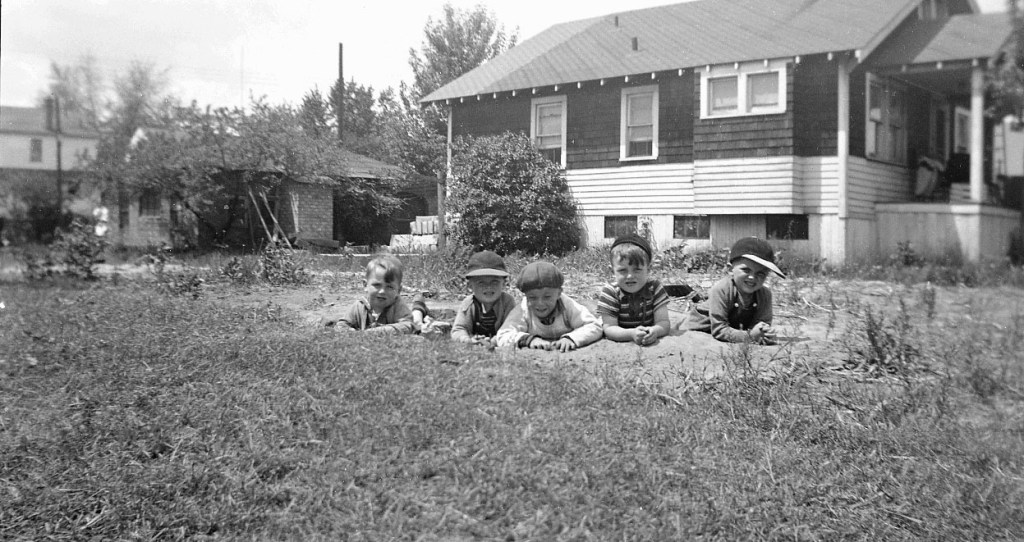
Front row: Five Berryhill kids ending with Phil. The kid looking to the left is David Blankenship. Tim was a baby.
The lot next door to us was vacant for a while before the Harris family moved in. Below is a famous family photo of a bunch of ruffians, my brothers included, in a fox hole. Our Uncle Dick saw the kids struggling to dig the hole so he got a big shovel and helped dig it at an awe inspiring pace. I wasn’t born yet.
Our uncle Bob and his wife, Bernice, lived just up Blackstone. They were mom and dad’s best friends at the time. We called him Uncle Bob but we were really cousins; he was the son of dad’s older brother Paul, and about 10 years younger than dad. They would come over regularly to play pinocle and drink beer. Bob and Bee had three kids at the time, Carrie, Diane, and Bobby. (See Steve’s writeup on Dave for more on Carrie). Their son David was to come later. It was great fun; Bob and Bee were highly entertaining. One of my early visual memories was of them drinking beer out of Pilsner glasses, sitting at the table playing cards, and laughing all night long. Dave told me he remembered Bob’s bellowing laugh.
Taking a nostalgic look back, it seems like our neighborhood was a working class version of Leave It To Beaver. Mom didn’t wear pearls and dad didn’t wear a jacket and tie to work, but we knew the neighbors and feuded with some of them. All the kids just ran the neighborhood after school and in the summer. No one had to make us go outside; we wanted to; and we mainly amused ourselves. The fire hydrant shown in the vacant lot picture above was the goal for hide and seek. No one called to arrange play dates. If you wanted to see your friends, you just went to their house and hollered their name.
Memories from Steve:
Around 1949 I used to do errands for Mr and Mrs Dent who lived on Blackstone a half block south of 15701. They were both quite old. I would get a dime for errands like bringing fire wood into the house for a wood-burning stove and heater. Mrs Dent was frail and old fashioned, but average for her age. She chastised Mom, “Why don’t you wear a dress?” Mr Dent was very brusk to me. When I was about to go to Lipsons grocery for them he cautioned me gravely, “Be careful when you cross Fenkell. A car could come and kill you in the middle of the street.” He would go into belaboring detail. Mrs Dent became upset and plead, “Oh, don’t say things like that. You will scare him.” …as though I never crossed Fenkell before.
One day a crowd gathered at the Dent’s house. The police were there. Mom, Dave, and I went to see what was up. Mrs Dent was in the back of the police car. Mom went up to talk to her. She sneaked up behind her husband while he was sitting on a lawn chair and hit him on the back of his head with a two by four. She told Mom she hit him 40 times. She was not as frail as I thought, although she could have been exaggerating. Mrs Dent waved to all the neighbors as the police drove her off.
After the police left and the crowd dispersed a little, Dave and I went to the side of the house and saw a rather clean lawn chair with a thick pool of dried blood on the lawn behind it. We looked for the two by four but couldn’t find it. We reasoned that the police must have taken it for evidence. We joked that Mr Dent’s head got dented. Mom found out where they took Mrs Dent and would go to visit her on occasion. It was not to a jail.
Everything was in the neighborhood. Fenkell Avenue was a few blocks south with most of the stores we needed: Lipson’s Grocery Store, Josephs Pharmacy, a clothing store, a hobby shop, and a movie house. I visited the old neighborhood a few years back, and the Irving Theatre had morphed into the Irving Art Theatre showing blue movies. Grand River Avenue, one of the main drags in Detroit, was a few blocks north and was a big shopping area. I remember riding the electric street cars with Mom, probably going downtown. The only familiar buildings standing are the Checker drug store (it’s soda fountain is probably gone). A solid concrete hardware store is still on Burt Rd and Fenkell, and still selling hardware. Across from the hardware store is another standby a solid concrete building which is now abandon, but I think was a bank.
Clint Harris has contributed his memories of the old neighborhood:
I remember 15701 Blackstone well from the perspective of 15709 Blackstone. Our houses were just a few feet apart. They were close enough together to allow whispered, post-bedtime conversations between Tim and the Harris boys through their windows. That was how we often planned the next day’s activities. But, looking at the photo of 15701, I realize I have forgotten something. The photo shows a dormer window projecting from the roof. I do not recall that. Was there a finished attic in the house? I do not recall a stairway.
The side yard adjacent to the Wilson house was the site of many touch football games and other activities In particular, I recall Dave and Steve using the side yard as a launch pad for their experimental rocket. I remember that we all hunkered down in the basement and watched out the window as the countdown began. It is perhaps fortunate that the rocket only attained about five feet of elevation before it disintegrated into dozens of pieces of tin and wood. I assume Dave’s rocketry skills improved when he worked for NASA.
The Berryhill Family was a troubled one. Bobby Berryhill was my age and I often walked to school with him. He had a hot temper that he once directed at me. Walking home from school one day, he took offense to something I said and came at me with fists flying. I grabbed him by the shoulders, in hockey fight fashion, and hung on. After some desperate clinging on my part, Bobby cooled down as quickly as he had flared up. Ronnie Berryhill, a year or so younger than me, was also rather volatile. As a group of us kids walked away from their house, The Berryhill grandfather came onto their porch and called out to Ronnie to come back home. His response was to raise his middle finger to his grandfather and shout out “F…k you old man.” They were a troubled family. Long after the Berryhill’s moved away, urban legend claimed that Bobby and his older brother Jimmy, died a violent death together when they mixed alcohol and a motorcycle.
None-the-less, The Berryhill’s were part of the “Leave It to Beaver” fabric of the neighborhood (remember Eddie Haskel and Rutherford.) Another sitcom of the time that seemed representative of our community was Jackie Gleason’s “The Honeymooners.” The characters Ralph and Alice Cramdin along with Ed and Trixie Norton just seemed like people that live in Brightmoor.
There are some published studies on Brightmoor, I think out of the University of Michigan, which I have read but regrettably did not save. The area started with Appalachian migrant workers living in tents along the Rouge River. A developer friend of Henry Ford launched the Brightmoor project to end the tent cities. It grew quickly and was annexed into Detroit in 1926. Looking back, I had often wondered about several abandoned buildings along Fenkel (one was at the southeast corner of Blackstone and Fenkel,) which may have been boarding houses back in the time of the tent cities. Prior to annexation, Brightmoor had no sewer system with homes having septic systems or even outhouses. I was interested to learn the source of the many homes in our neighborhood that had a house on one lot and a large yard in the adjacent lot. This resulted from the Brightmoor real estate policy of encouraging people to buy two lots with expected outcome that buyers would construct very cheap houses on one lot while they saved to build a bigger house next door. I think most double-lot purchasers, like The Gray’s across the street and Thompson’s next door to the Harris’s, built the house they wanted from the beginning and then enjoyed a large garden like The Gray’s had.
The last time I was in Detroit, I drove down Fenkel and also noticed that the old hardware, at the corner of Burt Road, still is a hardware. The building kitty-corner to the hardware, and also likely was at once a bank, is the old public library. Someone mentioned to me that the old library was offered for sale a few years ago for $5,000. There were no takers.
One block west of Burt Road, at the intersection of Fenkel and Trinity, there is no trace of three businesses we relied upon. On the southwest corner was Cliff’s barber shop which was the only place I ever had my hair cut until graduating from high school. It was an old school barbershop where patrons hung out after their haircuts to discuss the state of the world and, more importantly, why The Detroit Tigers were 14 games behind the Yankees.
On the northeast corner was a “dime store” which I cannot recall as being Kresge or Woolworth. There we purchased squirt guns, balsa wood airplanes and rubber animals for our sandbox farms. There was a two-story building on the northwest corner where shoe repair was on the first floor with the proprietor living on the second floor. The repairman worked alone which usually meant a wait to get his attention given the machinery noise and his concentration on what he was doing. Once he noticed the customer, the transaction was quick. In a Slavic accent as thick as his mustache, he would simply ask “What need?” He would examine the shoe and state a price. If the price was acceptable, and it was always reasonable, he would simply say, “come back Thursday,” and return to his machines.
One block west, at the intersection of Blackstone and Fenkel, on the northeast corner was a store that I think personified Brightmoor. In big block letters above the door and display window was written, “The Working Man’s Store.” Inside, the shelves and racks were filled with coveralls, work boots, leather gloves, hefty metal lunch buckets, sturdy suspenders, and all things needed by men who did not take a briefcase to work. That was just about all the workers in Brightmoor.
On the southwest corner of Blackstone and Fenkel was the grocery. I think it may have operated under more than one name over the years. My first recollection was the name Lipson Supermarket. The floors, I believe to have been wooden. There was not much floor space but there was a bakery, meat counter and produce section. What I do remember clearly was the parking lot. It was unpaved and not frequently maintained. Large holes and gravel pretty much precluded pushing a shopping cart to the car, especially so when rain or snow was added to the equation. But, unpaved parking lots were not unusual in the 50’s.
Another building important to us growing up on Blackstone was Burt Elementary School. I know that it has been unused for many years but I believe it to still be standing. A few years back I downloaded some Google pictures of it and have also taken some photos of the old school myself. They are here somewhere and I will add them when they are located. I have found a couple of photos of the Blackstone kids which are attached. The photos were taken on my first birthday (on or about June 30, 1947.) My mother was still in the hospital in the aftermath of bringing my brother Sherwood into the world. So, Mary Wilson provided me with my first birthday party. I recognize Phil on the right, Steve with bubblegum and Dave standing next to the two young girls. I suspect the two girls are Sherwood’s and my first babysitters, Poggy and Peggy Lawrence. Perhaps Steve can verify who they are. The Lawrences lived on Blackstone south of Midland next to the series of vacant lots we kids always called “The Creek.” Of course, there was no creek, just a boggy area with frogs and things that were fun to explore.

These memories are sweet, but I wonder how many are just forgotten. I will try to retrieve some more.
Clint Harris
Steve has some comments about Clint’s recollections:
The dormer window on 15701 was always there. As our family expanded, Dad wanted new space, so he got a ladder and pushed open a ceiling trap door in the bathroom to see how big the attic was. He let me go up with him. I was fascinated looking at the dormer window from the inside. The attic ceiling was too low. Dave and I later renovated the basement. Do you remember the train layout we had in the basement?
I had to laugh at your comment about Dave’s rocketry skills. His job at Honeywell was manager of the system flight controls. The Space Shuttle was steered by small lateral rocket jets. His team had to design the controls to mimic those in a plane because that’s what pilots are used to.
Yes the grocery store was called Lipsons for as long as I was on Blackstone.
The “Dime store” was an independent and had a sign the “5 & 10 cent store”. I only knew it by that name.
Next to Irving Theater and stretching to Westbrook were stores with apartments above. I delivered news papers to the second floor apartments along a long dark hallway that smelled of old world cooking.
Your picture of the kids is great. I don’t remember Peggy and Poggy’s faces (great names for sisters) although they both came to our house several times to watch TV. Other than the three Wilson brothers, the only other face I recognize is Terry Cotter who is between Phil and me. (Terry probably ended up in jail.)
Mrs Grey told us that there was a lot of open land in Brightmoor when they moved there. A stream actually flowed through the neighborhood. The Creek was part of the stream. The Grey’s saw the stream closed and a lot of land filled in to build houses.
Dave and I and some other kids collected old trees that were discarded after Christmas and built a huge bonfire in the Creek. Someone called the police who came after the huge conflagration burnt down to a tiny fire. They were disgusted to be called on such a trivial fire when we convinced them that’s all it ever was.
Steve
Cousin Joyce has a funny story about 15701:
We took Grandmother Cones (I called her Mama Cones) to Michigan when I was 6 or 7. The only memory I have is that your mother did not want her mother to know that she smoked. She would go next door to the neighbors. I guess everyone, (including me) knew where she was and why except my grandmother. It was a great secret for a little kid.
 Wilson Cones Family History